Odzun Church in Late May: Pale Stone, Arcades and Two Carved Stelae
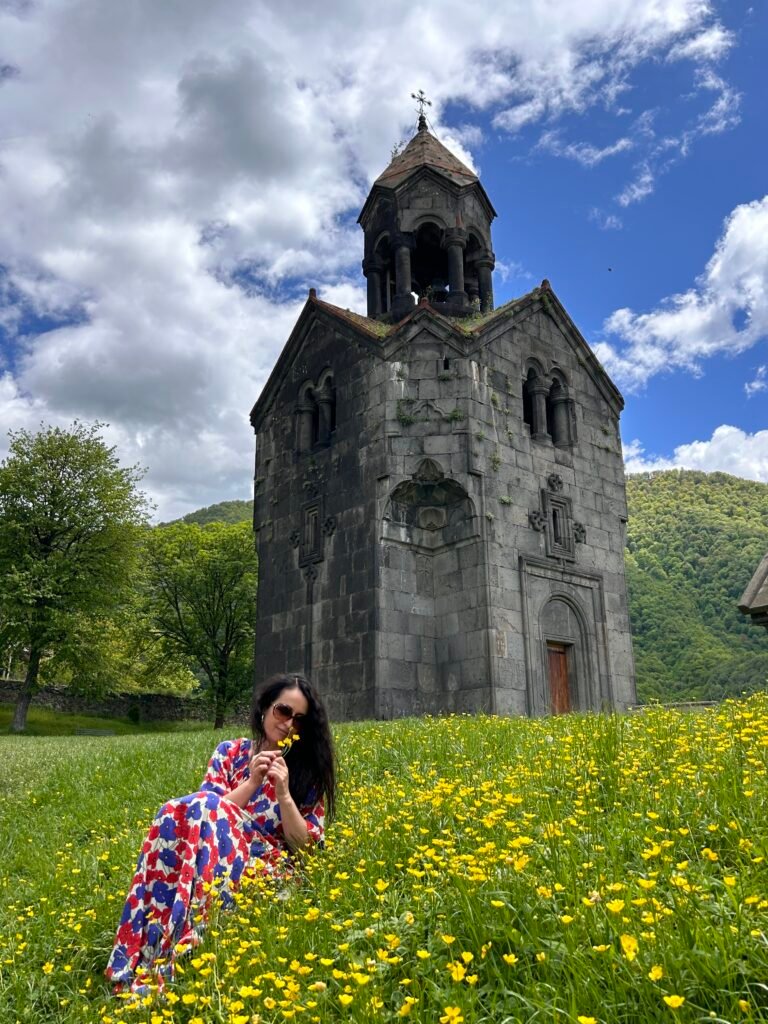
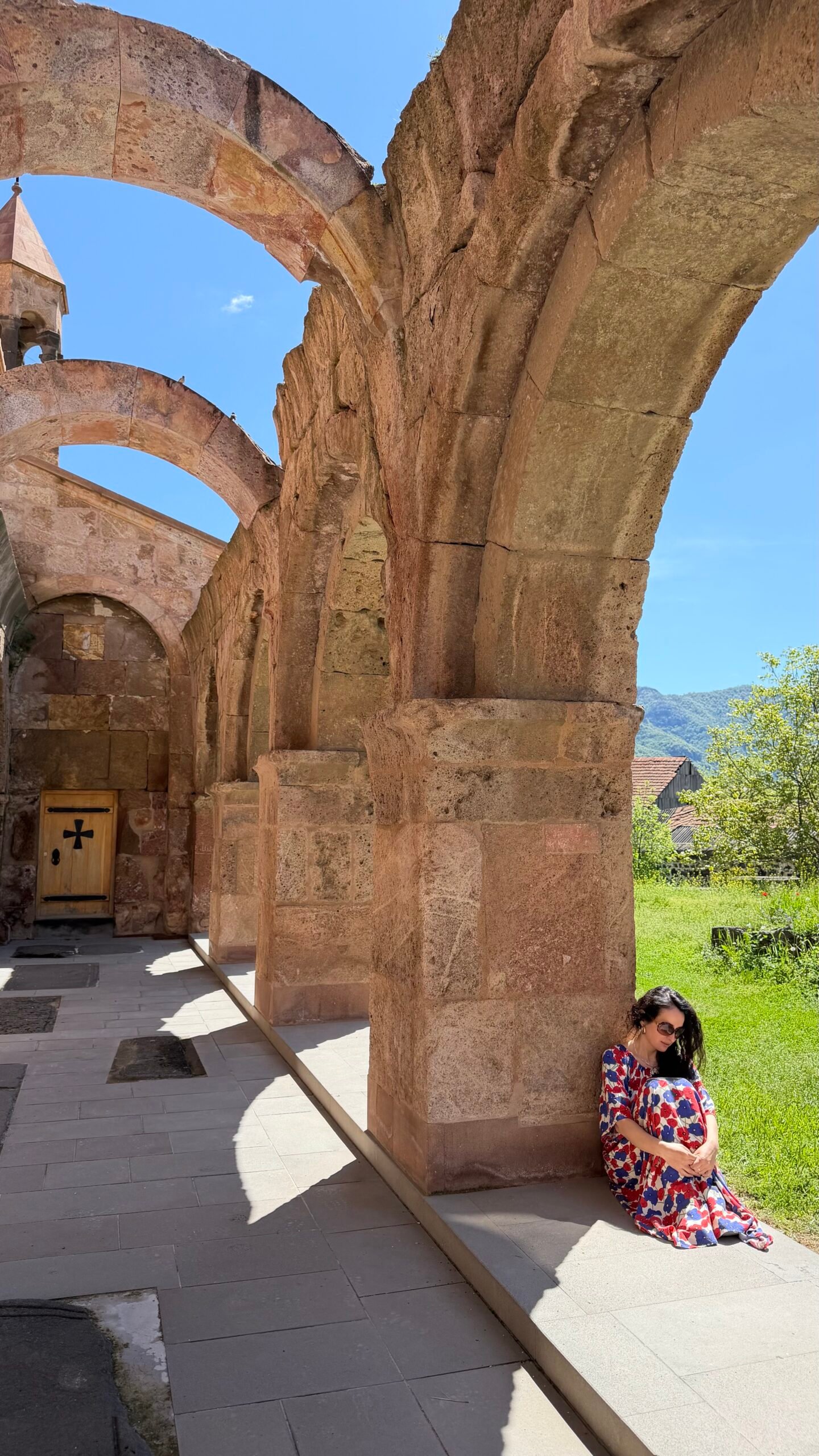
Odzun stays in my memory as light stone. I visited at the end of May, around the same time as Haghpat, and when I picture the two places side by side the difference is striking: Haghpat’s dark buildings against the green, and Odzun’s church pale and warm in the sun. I sat for a while at the foot of its arches before going inside.
Odzun is a village near Alaverdi in Lori. Its church, dedicated to the Holy Mother of God, is a domed basilica: a long building with a dome in the middle and arcades along the outside. It is built of pink felsite, which is why it looks so much softer than Haghpat’s dark stone.
Odzun at a glance
- Where: Odzun village near Alaverdi, Lori province, an easy day trip from Vanadzor by car.
- Built: sixth or seventh century, rebuilt in the early eighth century; two small bell towers were added in the late nineteenth century.
- Stone: pink felsite.
- Don’t miss: the funerary monument with two carved stelae beside the church, one of only two of its kind in Armenia.
- Entry: free.
Why the dates differ
You will see different dates for Odzun. Architectural historians generally place the church in the sixth or seventh century, with later work linked to Catholicos Hovhannes Odznetsi, who led the Armenian Church in the early eighth century and whose name means “of Odzun”.
A thirteenth-century historian wrote that Hovhannes “built a large church” here, but the word he used can also mean rebuilt, and the architecture points to an older building. The church you see today has several phases, and their exact order is still debated.
Walk around the arcades
The arcades are the best way into the building. Rows of open arches ran along the north and south sides, making a sheltered walkway outside the church walls; the northern one is now largely lost, and on the west a solid wall has a single arched entrance. Through the openings you can follow the church’s own wall and see how the outer passage wraps around it.
Take one picture along the arcade as well as one facing it. From an angle, the rhythm of the arches is much clearer, and you notice the spaces between the columns that disappear when your eye goes straight to the dome.
The light colour of the stone is what I remember most from May. In photographs, keep enough detail in the wall to see the separate blocks; if the bright light turns the whole surface white, you lose something particular to this church.
The two carved stelae
Beside the church stands something you won’t find in many places: a funerary monument with two tall, narrow carved stones, called stelae, each sheltered under a double arch on a stepped platform. Only one other monument like it is known in Armenia, at Aghudi in Syunik.
The east and west faces carry scenes in panels: biblical subjects and the story of how Armenia became Christian, including King Trdat III shown as a boar, from the legend of his punishment before his conversion. The narrow north and south sides are covered with plant and geometric ornament.
The carvings are worn, so a guide or an annotated photo helps. If the figures are hard to read, start with the layout of the panels and the way the arches protect the stones. You don’t have to identify every scene to see how carefully this small monument was made.
A message under the roof
Odzun also has a recent story I like. In September 2012, during restoration, workers removing the roof slabs found a sealed glass bottle holding a record of repairs made in the nineteenth century. In effect, one team of restorers had left a note for the next, and it was read more than a century later.
The same work uncovered early medieval ceramic tiles and carved fragments of khachkars, the Armenian cross-stones, from earlier periods of the building’s life.
Practical notes
- Getting there: I went with a local driver from Vanadzor. Odzun is on the plateau above the Debed gorge, near Alaverdi.
- Combine it with Haghpat: the two are on opposite sides of the Debed gorge and make a good pair for one day. Read my Haghpat guide.
- Services: Odzun is a working parish church. If a service is on, stay quietly at the back and save the close look at the stonework for later.
Questions people ask about Odzun
How old is Odzun Church?
Historians generally date it to the sixth or seventh century, with major work in the early eighth century. The exact sequence of building phases is still debated.
What is the monument next to the church?
A funerary monument with two carved stelae under double arches, usually dated by its style to the sixth century. It is one of only two such monuments in Armenia.
Is there an entrance fee?
No, the church is free to visit.