Armenian Gata: The Versions I’ve Tried and How to Choose One
The first thing I learned about gata is that the word covers a lot. I’ve eaten big round gata filled with nuts and cut into wedges, and small ones you can hold in one hand, made with sour cream or matsun in the dough. I’ve tried it in Yerevan, near Haghartsin Monastery and in cafés, and here in Vanadzor, where I live, many bakeries make gata alongside lavash.
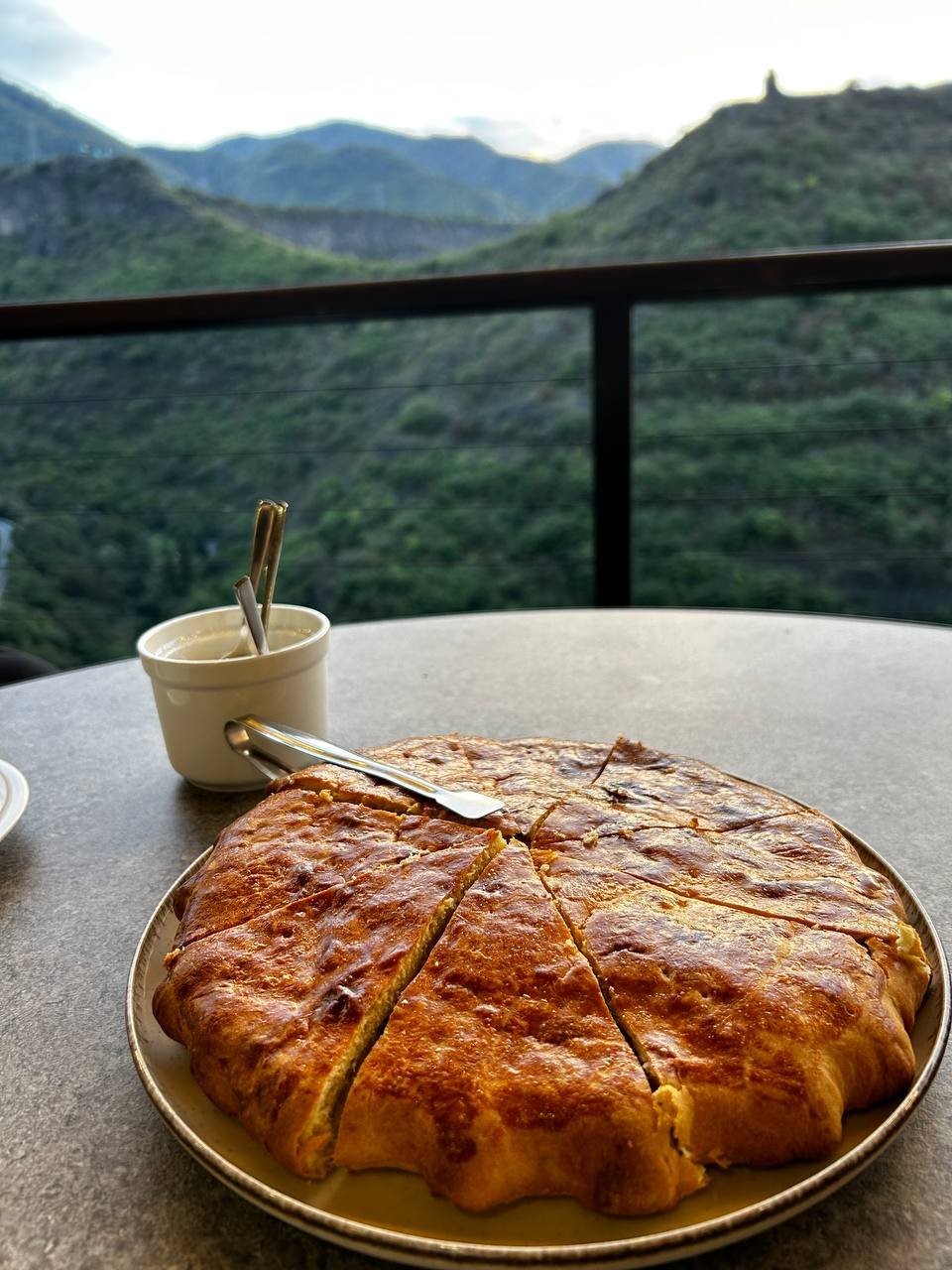
The round gata in my photo was served at Zarni-Parni, a cave complex with a small tavern near Haghpat Monastery, at a table looking out over the forested canyon. It makes a good stop if you are visiting Haghpat.
That variety is worth knowing before you buy your first piece. A large round and a small pastry may look like completely different things, but both can be gata, and the shape alone won’t tell you what is inside or how it was made.
What gata is
Gata is one of Armenia’s best-known sweet pastries. Depending on the recipe, the dough can be close to an enriched bread or to a layered pastry. Some bakers use yeast, others baking soda or baking powder.
Khoriz, the filling
The classic filling is khoriz: flour, butter and sugar rubbed together into crumbs. It stays slightly grainy after baking, so the pale layer you see in a cut piece is nothing like a smooth cream.
Some versions add walnuts. They are an extra, not a rule, and a plain khoriz gata is the best way to taste the butter-and-flour filling on its own.
Before your first bite, look at the cut edge. You may see one clear band of filling, or thin layers where the dough was rolled and folded. Two pieces with the same golden top can be very different inside.
Sour cream and matsun go into the dough
When a gata is described as made with sour cream or matsun, that usually refers to the dough, not the filling. Matsun is a fermented milk, often translated as yogurt, so a “matsun gata” is not a pastry filled with yogurt.
Published recipes show how much this varies. Chef Ruben Pogosyan’s recipe from Alaverdi uses sour cream in the dough and nuts in the filling. The Armenian cook Heghineh makes a round gata with matsun and milk in the dough and a plain butter, flour and sugar filling. So a round shape doesn’t automatically mean nuts, and a small one doesn’t point to a single recipe.
Gata at New Year
Gata is everyday food in Armenia, but it also belongs to celebrations. For New Year, many families hide a coin or a small token inside: whoever finds it in their slice is meant to have a lucky year. If you spend the holidays in Armenia, ask whether the gata on the table has a coin in it.
Buying gata in Vanadzor, and anywhere else
In Vanadzor I find gata in the same bakeries that make lavash, so buying it often happens alongside buying bread. That is the setting I would look for on a food trip: an ordinary neighbourhood bakery, as well as the stalls beside famous sights.
Ask what is in the filling and when that batch was baked. If you are curious about the dough, ask about that separately: an answer about walnuts tells you about the centre, an answer about matsun tells you about the pastry around it.
To compare, buy a little of two different kinds. Taste the edge first, then a bite through the middle, and notice whether the dough breaks into flakes or has a softer, bread-like crumb.
I’m still getting to know gata through the versions I find here. I haven’t yet tried the famous large rounds sold near Geghard Monastery; they are next on my list.
Questions people ask about gata
What is khoriz?
The sweet filling of gata: flour, butter and sugar rubbed together into crumbs. Some versions add walnuts.
Is gata a bread or a cake?
Somewhere in between. Depending on the recipe, the dough can be soft and bread-like or flaky and layered.
Does gata always contain nuts?
No. Walnuts are a common addition, but plenty of gata has a plain khoriz filling.